
France's Vanishing Surplus
How Europe's largest electricity exporter is about to run short on electrons to sell.
Europe’s heatwave and its effect on the electricity market are getting politicized, never mind the actual causal chain. In France, high temperatures forced nuclear reactors to throttle output. These plants often use river water for cooling, and environmental regulations limit how warm that water can be when returned to the river.
Politicians in France’s neighbor Germany predictably used the lowered nuclear output as proof that nuclear power is “the wrong path,” while conveniently ignoring that a 12% nuclear output reduction is modest compared to the near-total drop in wind generation caused by this week’s almost breezeless days.
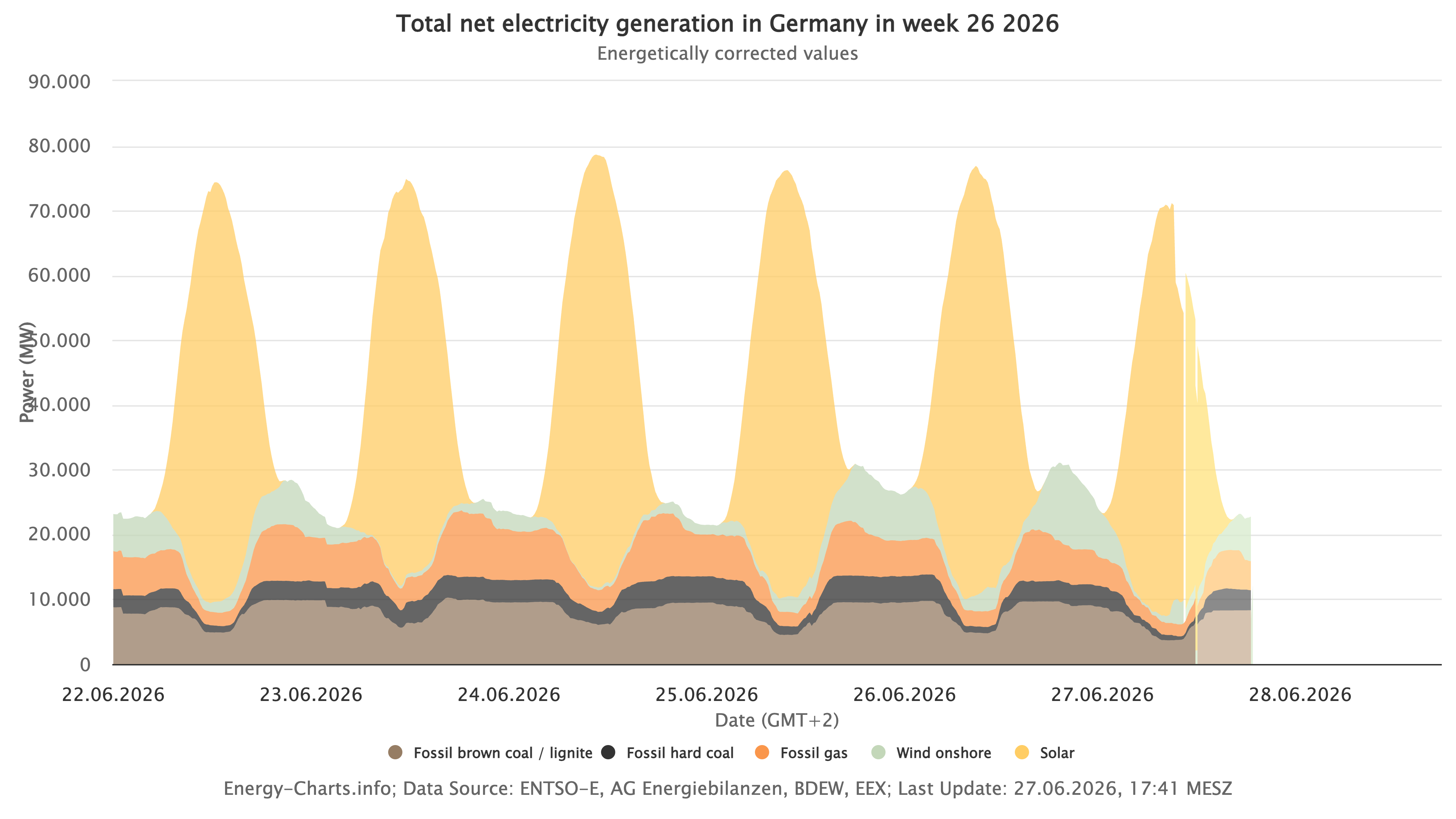
Curtailed output also pushes electricity prices higher, and those prices are a recurring theme in French politics. Both the left and right fringes have repeatedly argued that French customers are getting fleeced by Europe’s electricity pricing mechanism, demanding that France exit the European Union’s single energy market. Ahead of the French elections next year, these calls have been renewed this week.
As is the case in almost all industrialized economies, the European energy market runs on a system some people consider unfair: the merit order. In this system, generators submit bids to the electricity exchange. The last power plant that needs to be mobilized to balance supply and demand determines the price that all the resources called upon will receive.
The charge is that the marginal price overpays producers who submitted lower bids due to their lower operating costs. The “fair” solution, some say, is to pay each producer only its own bid. But since market participants tend to do what’s in their best interest, generators would stop bidding their real costs and start bidding their guess at the clearing price. The merit order would lose what makes it work: a price that reveals the true cost of each megawatt.
That marginal spot price serves a critical function: it informs operators and investors of what interconnection, cables, and generation capacity to build. Thus far, no one has come up with a fairer system that won’t destroy these price signals. Attempts at top-down control have only added a considerable layer of complexity, producing a price disconnected from the system’s physical constraints.
But France does not need to exit the single energy market or end merit order to reap the benefits from its low-cost generation. The market forces critics want to override are already moving the country into a position favourable relative to its neighbors. And unlike this week’s heatwave, that position won’t reverse when the weather does. Time to take a closer look.

France is Europe’s largest electricity exporter. In 2025 the French grid pushed a net 92.3 terawatt-hours (TWh) across its borders, more than what Belgium consumes in a year. That volume sells at a different price per unit. France’s system operator RTE puts the 2025 export price at €59 per megawatt-hour (MWh), just slightly below the French spot price. But that price balloons in the countries the electricity flows into.
Across the border, those electrons were worth €101.5 per MWh. In other words, French plants generate the most strategically valuable product on the continent—firm, dispatchable power—and capture barely half of what it’s worth the moment it reaches its neighbors. This raises the question of whether there is a more profitable use for these electrons. There is, and the difference is worth an order of magnitude.
Take again the number France earns today: €59 per MWh. Now route that same MWh into a data center sitting on French soil instead of exporting it. Industry estimates put traditional data centers at about $4.20 in annual revenue per watt of capacity. Spread across a year's run-hours and converted to the same unit, that's roughly €400 per MWh for conventional compute.
AI runs far higher. The same benchmark puts AI facilities at $12.50 per watt, while a separate, bottom-up breakdown of AI data center unit economics lands at roughly $15 million in annual infrastructure revenue per megawatt of capacity. Together they put AI compute between €1,300 and €1,800 per MWh. The exact figures move with utilization, build type, and a volatile market for AI compute, but the size of the gap is not in question: the electron is worth seven to thirty times more as compute than as exported power.
France does not capture the full value, of course. The compute margin accrues to the data center operator, often American hyperscalers. However, the country banks the slice it can tax: corporate income booked domestically, property and local levies, construction and operating wages. The inevitable result: An electron consumed at home anchors a high-value activity that pays French tax, while the same electron exported produces a meager commodity invoice.
The buyers are already here. French data centers drew about 10 TWh in 2024. France’s Agency for Ecological Transition (ADEME) trend path puts them near 37 TWh by 2035. That increment alone—27 TWh of new demand—is larger than the entire net export France sent Germany and Belgium in 2025.
Of course, all this rests on the assumption that AI will become profitable at some point. French politicians also have to execute correctly on the gift of this infrastructure that’s been handed down by a generation of politicians that—looking back—has proven to be of superior competence. The political will for that kind of independence may exist: France reportedly called the US-led “Pax Silica” initiative an attempt to colonize Europe. But since Brussels can’t make enough advanced chips at the cutting edge to go it alone, joined the pact anyway.

From the perspective of generators, having a data center as a customer is beneficial. In contrast to neighboring countries with fluctuating demand, a data center runs flat, around the clock, near full capacity, indifferent to season and spot price, and it signs long contracts to do so. As a result, the firm electron goes to this customer first, ahead of the leftover the export market takes.
For the countries losing out, viewing the loss on the annual average understates the problem. Because the shortfall shows up in the cold, dark, windless winter hours, when their own demand peaks and renewables vanish. What fills the gap when the French import thins is whatever sits next in the stack.
For Germany, which has retired its nuclear and is phasing out its coal, that means gas. The hours it can least afford the exposure are the hours it now leans hardest on the one dispatchable source it has left. And because power clears at the margin, a few GW of missing French import don’t just cost the volume they represent. They reset the price for every MWh in that hour, up to whatever the gas plant bid. The unwritten assumption behind the renewable build-out—that firm power next door would always be there—no longer holds.
This week’s stress test is caused by heat, and it passes when the weather breaks. A must-run data center claiming France’s firm capacity does the same thing, year-round, and it doesn’t break.
Share this with anyone who thinks an electron is worth the same no matter what it’s used for!
📨 People in boardrooms, energy desks, and hedge funds keep forwarding this. Stop getting it late — subscribe now!
I imagine the response from Brussels will soon be an EU directive that doesn't permit France from determining what to do with its own electricity, it is a common good and Brussels will make the decisions.
So France is selling its electricity with a big discount (and on demand !) to its neighbours.
One can wonder what kind of political arrangement there is here and what's exactly there is for France in such a deal ?
Implicit German guaranty and thus cheaper interests on borrowed money France need so much ? Or it is already third world country economy style ? Selling cheap its "natural" ressources while being unable to make a more profitable use at home by a mix of external pressure, internal corruption, lack of qualified manpower and so on ?...