
Entropy Wins Every Time
Why the Ukraine War Will End Abruptly
Calling someone a war profiteer carries unsavory moral weight. No one wants to admit they’ve benefited from the suffering of others. Yet that’s precisely the charge Denmark has levelled at Norway. The accusation: Oslo pocketed windfall profits from the global surge in energy prices between 2022 and 2023 after Western sanctions on Russian supplies.
Of course, cutting yourself off from a major supplier and then calling the remaining one a profiteer is a bit rich. Besides, supply and demand set prices, and those who can deliver a scarce good do so because they took the entrepreneurial risk and accept the downside when it comes.
Nevertheless, Norwegian politicians are urging the government to embrace the “war-profiteer” label and crack open the country’s €1.8 trillion state pension fund to support Ukraine. More precisely, Norway is being asked to guarantee the Commission’s €140 billion loan to avert Ukraine’s bankruptcy at the end of March. The program has stalled as Belgium continues to block the use of frozen Russian sovereign assets as collateral until other member states provide financial guarantees.
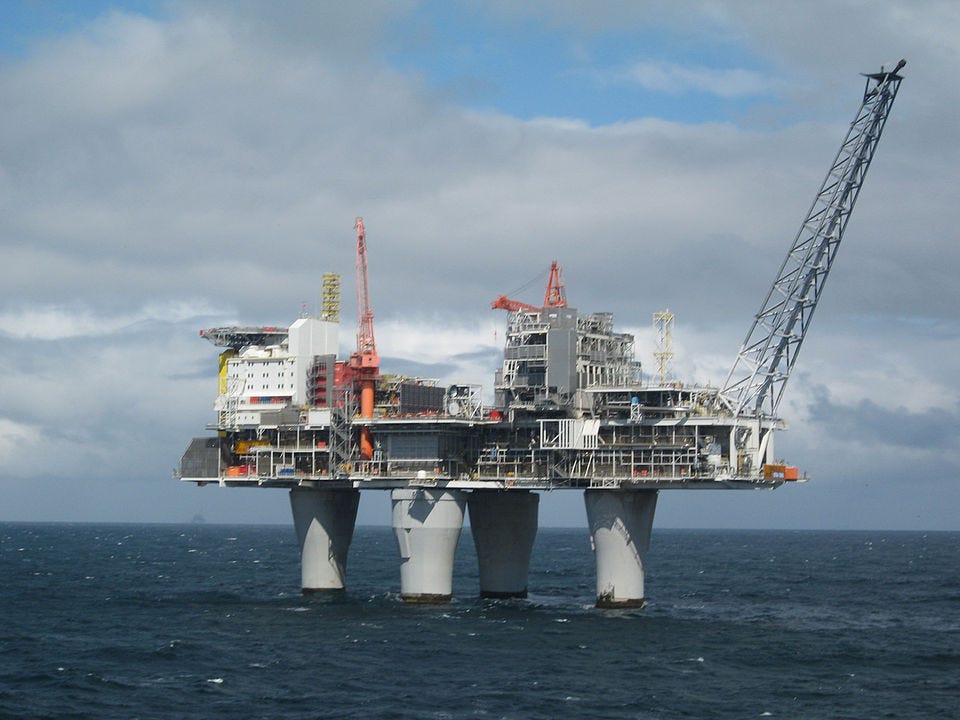
Norway’s finance ministry has noted that the country did, in fact, earn “extra income” from high energy prices, a calculation that could make the plan politically viable. The country offering up its state pension fund—the nest egg built on decades of energy exports—as collateral may come as a surprise.
But Norway’s finance minister is Jens Stoltenberg, the former NATO secretary general. His enthusiasm for keeping the conflict afloat aligns perfectly with the conviction he voiced in his former role that Ukraine will not only prevail, but eventually join NATO. Therefore, it’s less a question of if than when Stoltenberg will act to support the additional two to three years of fighting that Zelenskyy says Ukraine still needs.
However, Stoltenberg’s conviction that Ukraine can prevail ignores the growing entropy beneath the surface: energy, politics, and demographics all point to rapid unraveling. Let’s take a closer look.
👀 Reading this from a forwarded email? Subscribe to The Brawl Street Journal to get it straight from the source…
Ukraine’s energy system has been regularly targeted by Russia since the start of the war in 2022. Around half of its power-generating capacity has been disrupted—either destroyed or stranded in occupied territories—so the situation has always been strained. Before every winter, Russia increased the tempo of its attacks, focusing on substations and switchyards around nuclear plants to force reductions in output and create grid instabilities. This approach triggered rolling blackouts and outages affecting millions of Ukrainians.
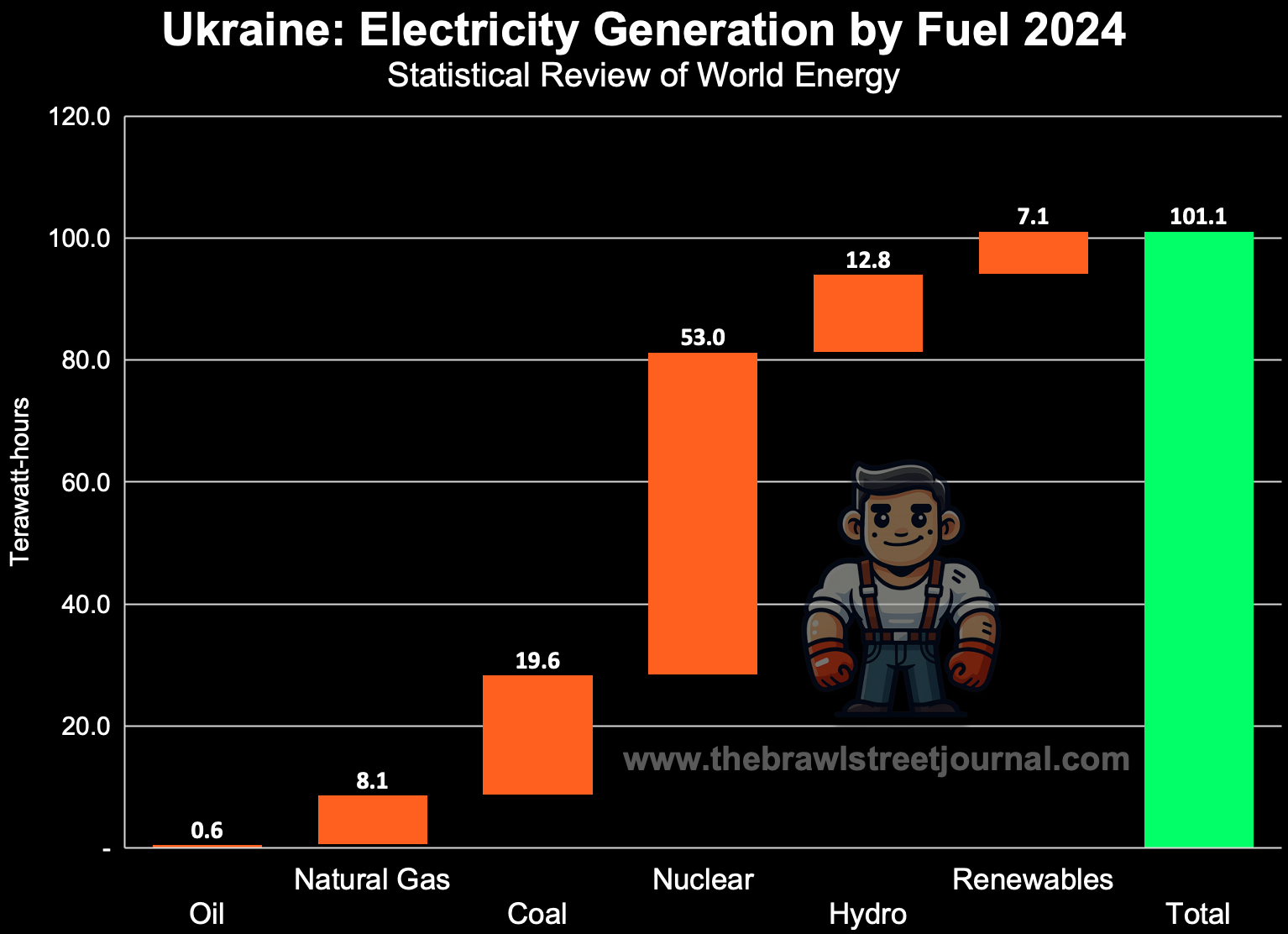
For obvious reasons, Russia has refrained from striking nuclear plants directly, which provide the bulk of Ukraine’s electricity. Ukraine has also proven remarkably resilient, repairing damaged sites and restoring capacity faster than many expected. Russia, however, remains technically capable of far greater destruction. Its choice to inflict calibrated rather than total damage indicates a strategy of coercion, not annihilation.
Leaving parts of the grid functional meant having something to offer—or withhold—in potential negotiations. If everything were already destroyed, that bargaining chip would vanish. Yet as the war drags into its later stages, that restraint appears to be eroding. Russia now seems willing to inflict unprecedented damage as other options dwindle. According to Rybar:
The destruction of Ukraine’s energy sector has become a military-political objective in recent weeks. It is clear that strikes on enemy power plants are finally substantial and aimed at disabling key facilities. The defeat of outgoing power lines at the enemy’s remaining nuclear power plants has become important, with power units reducing capacity. Some of the remaining operational thermal power plants are increasing electricity production to compensate for losses. However, this also rapidly wears out the system.
In the past, Rybar and other pro-Russian feeds described energy strikes usually as “retaliatory” or “pressure.” The new phrasing—“military-political objective”—marks a doctrinal upgrade. The emphasis on attacks now being “finally substantial” implies a shift in both volume and precision, signaling that the campaign seeks permanent degradation, not temporary outage.
The data points in the same direction: a “huge attack” on energy infrastructure in December 2024 involved ninety-three missiles and roughly 200 drones. By contrast, the UN reported that a late-October 2025 assault used 705 munitions. The escalation speaks for itself.
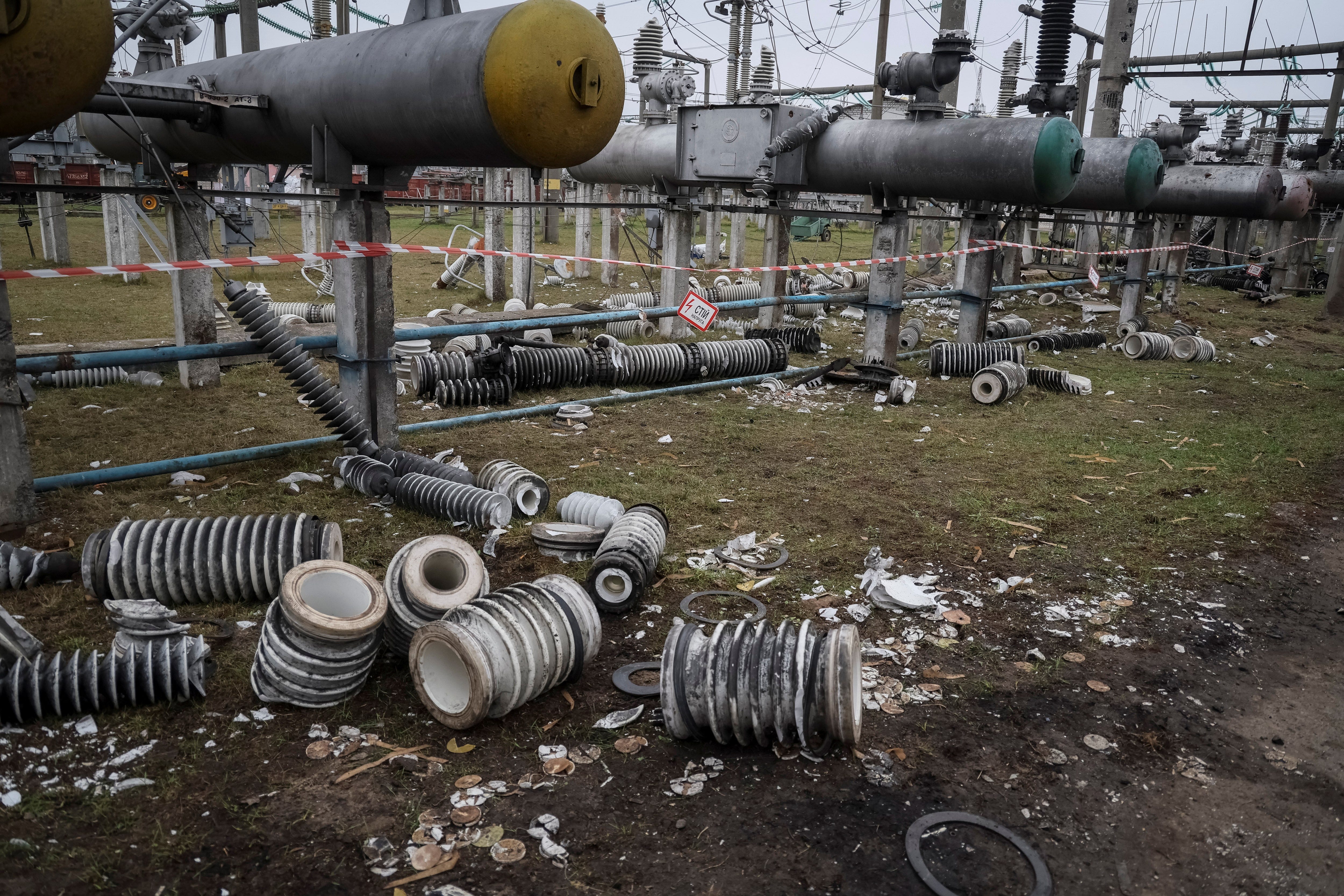
Ukraine is about 70 percent urban, with five major cities of more than 900,000 residents each. The country’s highly centralized infrastructure means that a loss of electricity cascades quickly—cutting water, sewage, and heat. In such a system, blackouts quickly dissolve the basic functions of urban life. Large cities like Kyiv, Kharkiv, or Dnipro become ungovernable within days of sustained outages. The entropy that is set to unfold in the energy system is already visible at the political level.
Last week, Politico published a piece, titled “The Dark Side of Zelenskyy’s Rule,” describing how the man credited with keeping Ukraine’s grid alive has become a target of the president’s lawfare campaign. Kudrytskyi, the head of the state-owned power operator Ukrenergo, had earned global respect for maintaining electricity through successive waves of Russian missile and drone attacks. Yet in 2024, he was forced to resign:
At the time, Kudrytskyi told POLITICO he was the victim of the relentless centralization of authority that Ukrainian President Volodymyr Zelenskyy and his powerful head of office Andriy Yermak often pursue. He said he feared “corrupt individuals” would end up taking over the state-owned company.
According to his supporters, it is that kind of talk — and his refusal to remain silent — that explains why Kudrytskyi ended up in a glass-enclosed cubicle in a downtown Kyiv courtroom last week, where he was arraigned on embezzlement charges. Now, opposition lawmakers and civil society activists are up in arms, labeling this yet another example of Ukraine’s leadership using lawfare to intimidate opponents and silence critics by accusing them of corruption or of collaboration with Russia. Zelenskyy’s office declined to comment.
Another instance of this political lawfare is Zelenskyy’s predecessor, Poroshenko, sanctioned and arraigned on corruption charges this year, a move that could prevent him from running again. In the port city of Odesa, Mayor Trukhanov—a colorful character who once survived $25 million in corruption charges—was stripped of his citizenship over allegations of holding a Russian passport. A military administration was installed to govern the city.
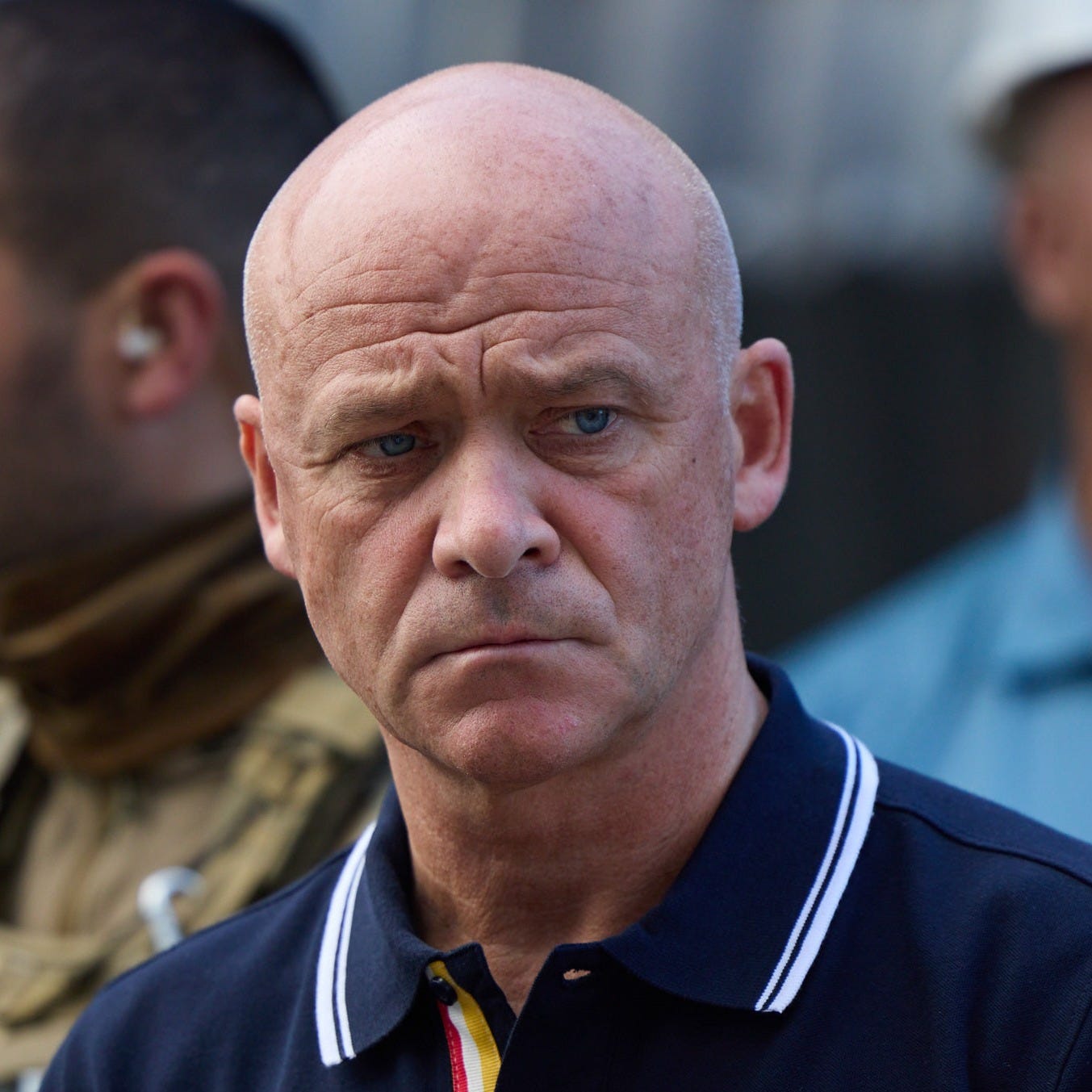
Taken together, these cases reveal a pattern common in times of crisis: when those in power sense their position eroding, they tend to neutralize rivals, indicating a decline of dominance.
The same pressure that drives leaders to consolidate authority is also pushing Ukrainians to leave, especially those the state can least afford to lose. As of August, 4.37 million Ukrainians were living in the EU. About 23%—nearly one million—are adult men, roughly the size of Ukraine’s entire armed forces.
The Telegraph reported that an additional 100,000 fighting-age men have fled in the past two months, following a new rule allowing Ukrainians to travel abroad before turning 23. The idea was that granting young men limited freedom to leave might encourage them to return and volunteer later. Instead, the opposite seems to be happening. This latest exodus suggests few intend to come back any time soon. Every departing citizen takes a bit of the state’s remaining power with them.
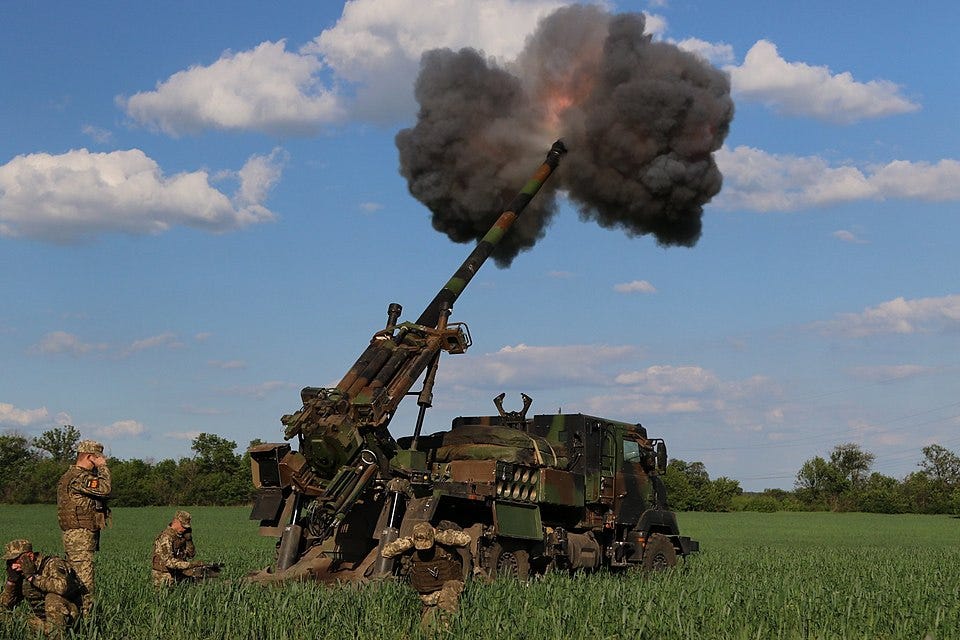
As political power grows fragile and the population visibly war-weary, a winter energy crisis could bring this war of attrition to an abrupt end. Russia’s targeting of electricity infrastructure resembles NATO’s 1999 campaign against Serbia, when strikes on major transmission facilities caused widespread and prolonged blackouts. Those electrical disruptions destabilized Milošević’s rule, proving decisive in ending the war. The same pattern is taking shape in Ukraine.
Europe, meanwhile, will hardly withstand the shock that follows. It cannot keep absorbing another system’s disorder without disintegrating itself. Just days ago, the IMF warned that Europe’s “explosive” public debt will require a revision of the social contract.
The longer this war drags on, the more of Ukraine’s basic infrastructure will be destroyed, the more refugees Europe will have to absorb, and the more it will have to pay to make that territory livable again. At some point, Europe will beg Norway to tap its pension fund to soften the blow of the “radical fiscal measures” the IMF says are coming.
Share this with anyone betting on a long war!
📨 People in boardrooms, energy desks, and hedge funds keep forwarding this. Stop getting it late — subscribe now!
Already subscribed? Thanks for helping make BSJ quietly viral.
I am surprised that Norway is willing to throw its nest egg into the fray, since it's not going to get anything out of it, and it will not recover that money either. Its a simple shakedown from one place in Europe that still has any liquidity, where touching Russian assets is a dicey.
It just goes to show that transnational elites, like Stoltenberg, will treat even their home countries like disposable tools.
The weakness of Europe's financial system is both a key cause of this war, and a key limitation upon it. That's why, even though they are not winning, they cannot stop trying.
It's also why, unless something unforseen happens, they will consume their entire political project on this pyre. Including Norway's state funds. So the war may end abruptly, but it may not end soon.
The Davos powers are hoping against hope that some unforseen event or combination can induce Russia to sue for peace without a win. In contrast, Russia appears to have accurately judged the nature of its opponent, and is relying on an attrition strategy that brings its enemies and their material assets to it. In so doing, they have degraded NATO's militaries - but not ended the war.
Blacking out Kiev for winter is an escalation, but how long did Leningrad hold, and under what conditions? So long as the Ukrainian regime's goons are on hand to shoot dissidents, and mines and drones retain their current effectiveness, the war will continue until either the regime goons are gone, or Europe's finances are. Which is why the number of dead Azovite types around Pokrovsk is a more hopeful sign than the number of dead power plants around Kiev.