
Overcapacity
Europe is fighting its economic war on the wrong front.
Germany’s power grid is an engineering achievement on which the country’s postwar industrial dominance was built. Despite the reckless addition of intermittent generation capacity in the last two decades, the average German consumer experienced only 11.7 minutes of electricity interruption for the entire year in 2024. That’s an annual failure rate of 0.002%. For a visible example of the link between extreme grid unreliability and economic dysfunction, one must only look at Cuba.

Against that backdrop, a recent proposal by Federal Network Agency (Bundesnetzagentur) president Klaus Müller deserves more attention than it has received. The agency is preparing a new pricing framework for industrial consumers: capacity charges, surcharges for exceeding contracted capacity, and flexibility incentives. In his own words:
We enable commercial and industrial consumers more flexibility in electricity consumption. There are great opportunities to respond more strongly to low electricity prices. Large consumers and the power system benefit equally.
Müller’s mandated task is to keep the grid reliable. But he is also a Green Party member, and as such his allegiance is to follow the net zero dogma without deviation. Bringing both imperatives into alignment is what his call to give “commercial and industrial consumers more flexibility in electricity consumption” aims at. Beneath the flowery language, an unrelenting constraint is hiding. Electricity production and consumption must match in real time, or the grid fails. If production follows the weather, consumption must follow it too. Hum during the breeze, go quiet during the cold doldrums. Production a function of meteorology.
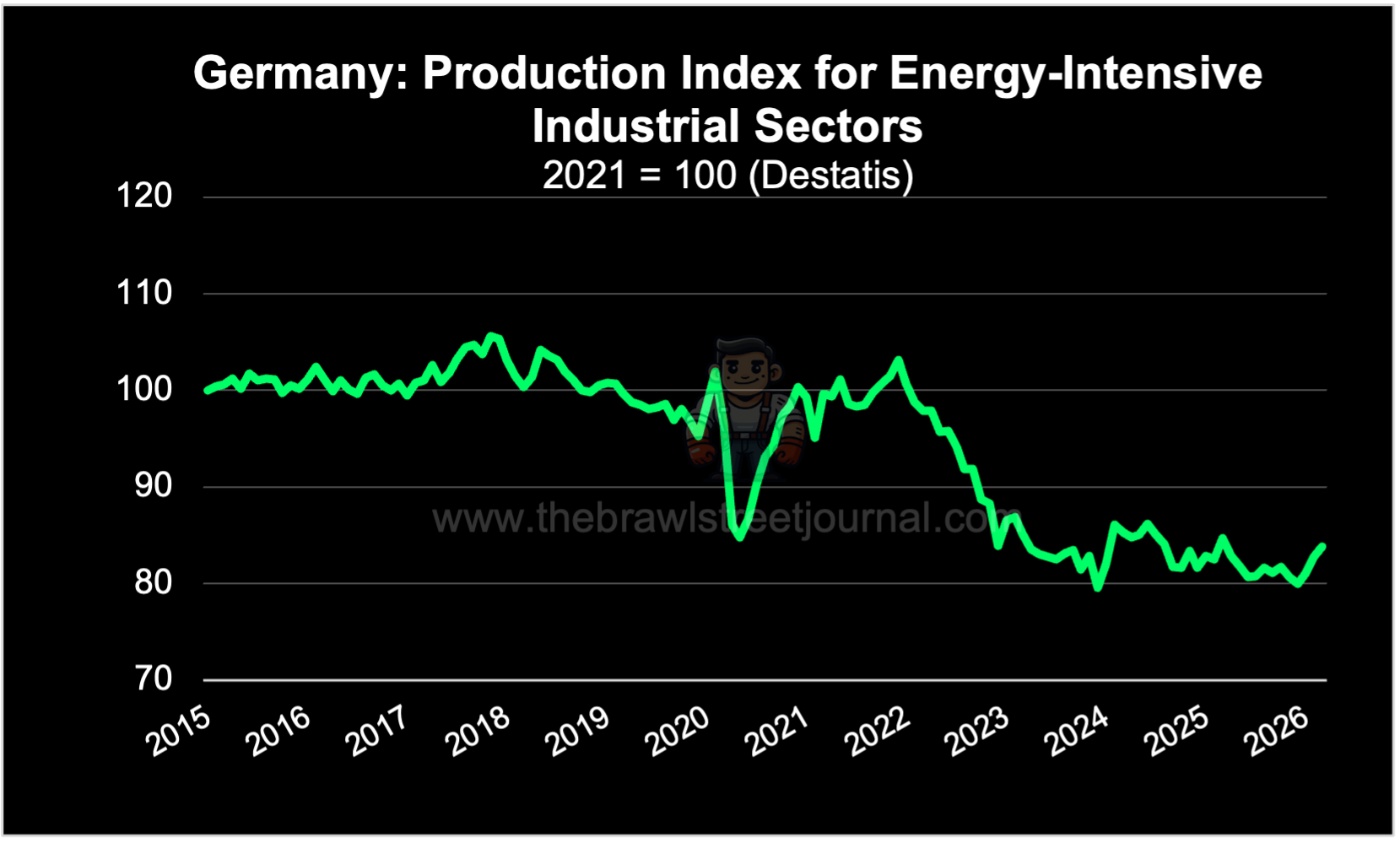
Germany’s energy-intensive production is already in decline. As the Federal Statistical Office reports, production in energy-intensive industrial sectors fell 15.2% on a seasonally and calendar-adjusted basis from February 2022 to March 2026. Asking factories to shoulder some of the highest energy costs in the industrialized world is one thing. Telling them to only keep the machines running when the weather permits is the next escalation step that guarantees another wave of departures. Müller’s pilot runs through 2026, final rules land early 2027.
Germany is only the leading edge of a European energy policy that has made the same bet at continental scale. The EU’s Renewable Energy Directive sets a legally binding target of 42.5% renewable energy in the total energy mix by 2030. A target which does not bend for rising prices or industrial exit.
Instead of solving Europe’s self-inflicted competitive problems, Brussels is now drafting a move to export the consequences onto others. The plan is to discipline the country that benefited most from Europe’s self-inflicted energy disorder: China. The EU is looking to unleash a trade fight over the two economies’ growing trade imbalance. One instrument has been given remarkably little scrutiny, even though it stands in direct and obvious contradiction to the EU’s sacred energy transition. Time to take a closer look.

The proposal is called the “overcapacity instrument,” which the EU’s College of Commissioners discussed on May 29th. The term “overcapacity” has no formal definition in this context. The Commission’s working standard: China accounts for 30% of global production but only 13% of consumption. That gap alone is sufficient grounds for restriction. No predatory pricing, no dumping, no market manipulation required.
A March 2026 European Parliament study titled “Industrial Overcapacities with a Focus on China” backs this framing, flagging “high levels of investment in production despite low levels of domestic consumption” as inherently problematic. By that definition, every competitive exporting economy in history has been guilty. The Chinese commerce ministry hit back accordingly:
If we label trade surpluses as “overcapacity,” then should EU’s exports of automobiles, pharmaceuticals, wine and cosmetics also be labeled as “overcapacity”?
The “overcapacity instrument” would allow the bloc to restrict Chinese access to EU markets in sectors where China’s production significantly exceeds demand. Few specific details have been officially disclosed since the proposal remains closely guarded.
The instrument’s current primary targets reportedly are chemicals, machinery, and plug-in hybrid cars. But the Commission’s own threshold — 30% of global production against 13% of consumption — does not stop there. Applied consistently, it catches two sectors that sit at the physical foundation of the EU’s energy transition: solar panels and batteries. China produces approximately 80% of global solar modules against domestic absorption of roughly 35%. Batteries have a similar production to absorption ratio. Both clear the threshold by a wide margin.
For solar, Brussels has already tried something similar. Between 2013 and 2018, the EU imposed anti-dumping tariffs on Chinese solar panels. The outcome was a failure: no significant European manufacturing capacity was built. Instead, a long string of insolvencies culminated in the flagship of German solar manufacturing, SolarWorld, going bust during that time and the dependency deepened. In 2023, 98% of solar panels installed across the EU came from China.
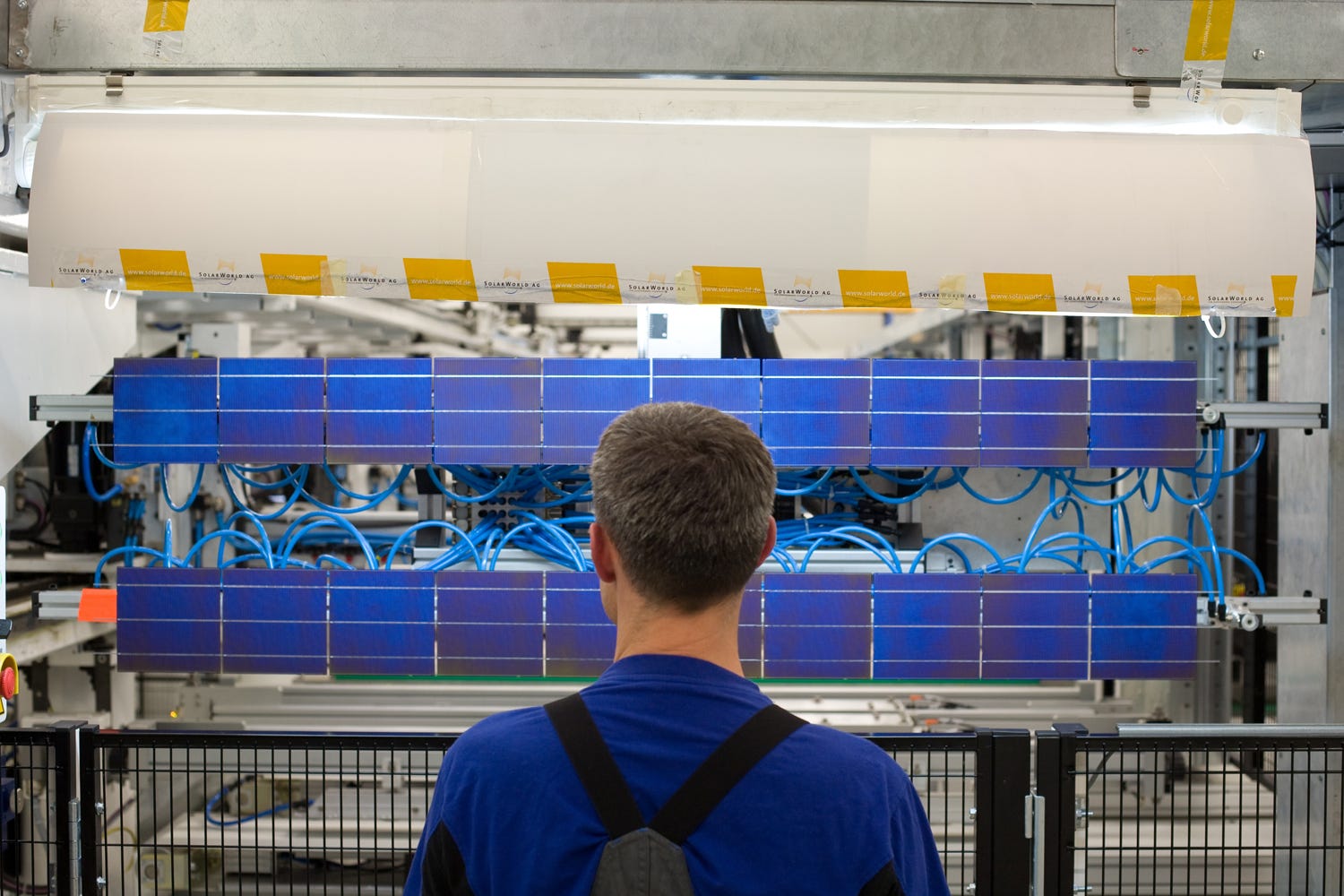
What the “overcapacity instrument” will achieve is that the energy transition becomes even more expensive. The EU wants to reach 600 GW of solar PV capacity by 2030 from 406 GW in 2025. As Chinese panels are about 2.5 times cheaper than European ones, restricting Chinese supply either requires taxpayers to cover penal import duties through higher renewable subsidies or developers to absorb the cost delta, who will then find ways to pass it on to ratepayers regardless.
One result can already be ruled out: European polysilicon and wafer manufacturing will not scale to the required roughly 50 GW per year within this decade. Current manufacturing capacity is at approximately 5 GW, according to Bruegel. There is no subsidy large enough to conjure that capacity into existence. Similar math can be run for batteries.
The likely outcome: Brussels will carve solar and batteries out of the instrument’s scope. Both are some of the biggest overcapacity sectors by the Commission’s own threshold, and both are untouchable for energy transition reasons. That exemption exposes inconsistency and reveals the instrument for what it is: selective industrial protection disguised as a principled trade standard.
But like the EU’s Anti-Coercion Instrument before it, the application of the “overcapacity instrument” will be so slow and predictable that China can read the direction of travel months in advance and respond accordingly. While Brussels holds talks to decide what to exempt from the instrument’s scope, China restricts rare earth exports as it did in November 2025.
The entire effort is a self-defeating attempt to compensate for Europe’s own uncompetitiveness by penalizing the trade partner that outcompeted it. China is obviously not an innocent bystander. Europe is dismantling its industrial base and bleeding its taxpayers to hit climate targets that its second-largest trading partner (and the world’s largest coal burner) treats as aspirational. Even the Financial Times had to concede this week:
At present, China is not on track to meet its goal of carbon neutrality by 2060 in large part because of its rise in coal use to meet its demands, despite world-beating efforts to electrify energy and transport.
There is a direct correlation between energy abundance — using every source available — and the industrial capacity to pursue ambitious goals. China burns coal at scale and leads the world in electrifying energy and transport. The EU fails to see that this correlation explains its trade deficit with China. A bloc whose biggest economy has shed 15.2% of energy-intensive output and is now being told to schedule production around the weather forecast will not become competitive regardless of how many trade war instruments Brussels reaches for. When all you have left is trying to trip the runner ahead, you’ve already lost the race.
Share this with anyone blaming China!
📨 People in boardrooms, energy desks, and hedge funds keep forwarding this. Stop getting it late — subscribe now!
As an American, I am confused by this proposal as I am almost certain that when President Trump imposed tariffs around the world in April 2025, the Europeans were highly critical of the concept that anybody should impose tariffs on trade. I must be confused about that.
Alas, I fear the poor citizens of Europe will become poorer still as this process plays out, until it stops. I see the populist/rightward shift in Latin America, where the people seem to be tired of platitudes and instead want economic growth and safe streets and have a feeling that same desire will manifest in Europe. I just hope, for your sakes, it happens before the Greens destroy what's left of industry there.
So if I understood the gist of this article correctly, if you produce more than you consume then you’ll be penalised… Sounds like socialist thinking to me. Penalising those who are productive, making us all mediocre. And as you correctly pointed out, there are some things that the EU also produces in excess of their own demand.