
Routing the Conflict
The Pipeline That Signals Whether Peace Is Real
For decades, the conflict between Armenia and its long-time enemy Azerbaijan was treated as one of the post-Soviet world’s unsolvable disputes. It began over Nagorno-Karabakh, a region internationally recognized as part of Azerbaijan but historically populated by Armenians. In 2023, Azerbaijan recaptured the disputed territory, prompting the flight of virtually the entire Armenian population. This was not the first mass displacement tied to the conflict: in the 1990s, more than 500,000 Azerbaijanis were forced from their homes.
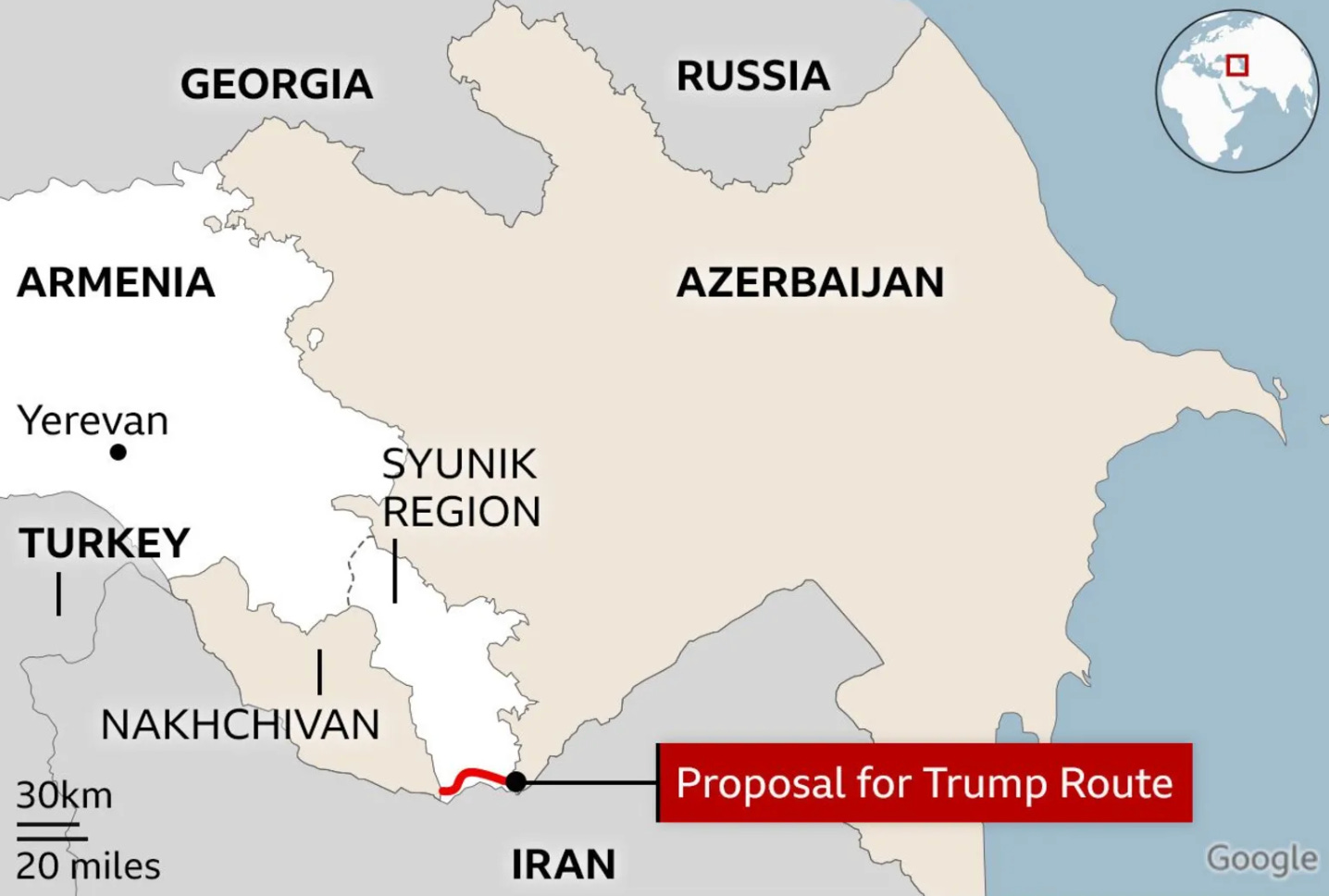
In August 2025, Trump unexpectedly broke the deadlock by treating the conflict as a routing problem. The plan envisions U.S. companies moving in under a 99-year agreement to develop a 43-kilometer (26-mile) corridor through Armenian territory along its border with Iran. The route would link Azerbaijan to its exclave of Nakhchivan and include railways, roads, oil and gas pipelines, and fiber-optic cables. Construction is scheduled to begin next year, creating what Washington has dubbed the Trump Route for International Peace and Prosperity (TRIPP).
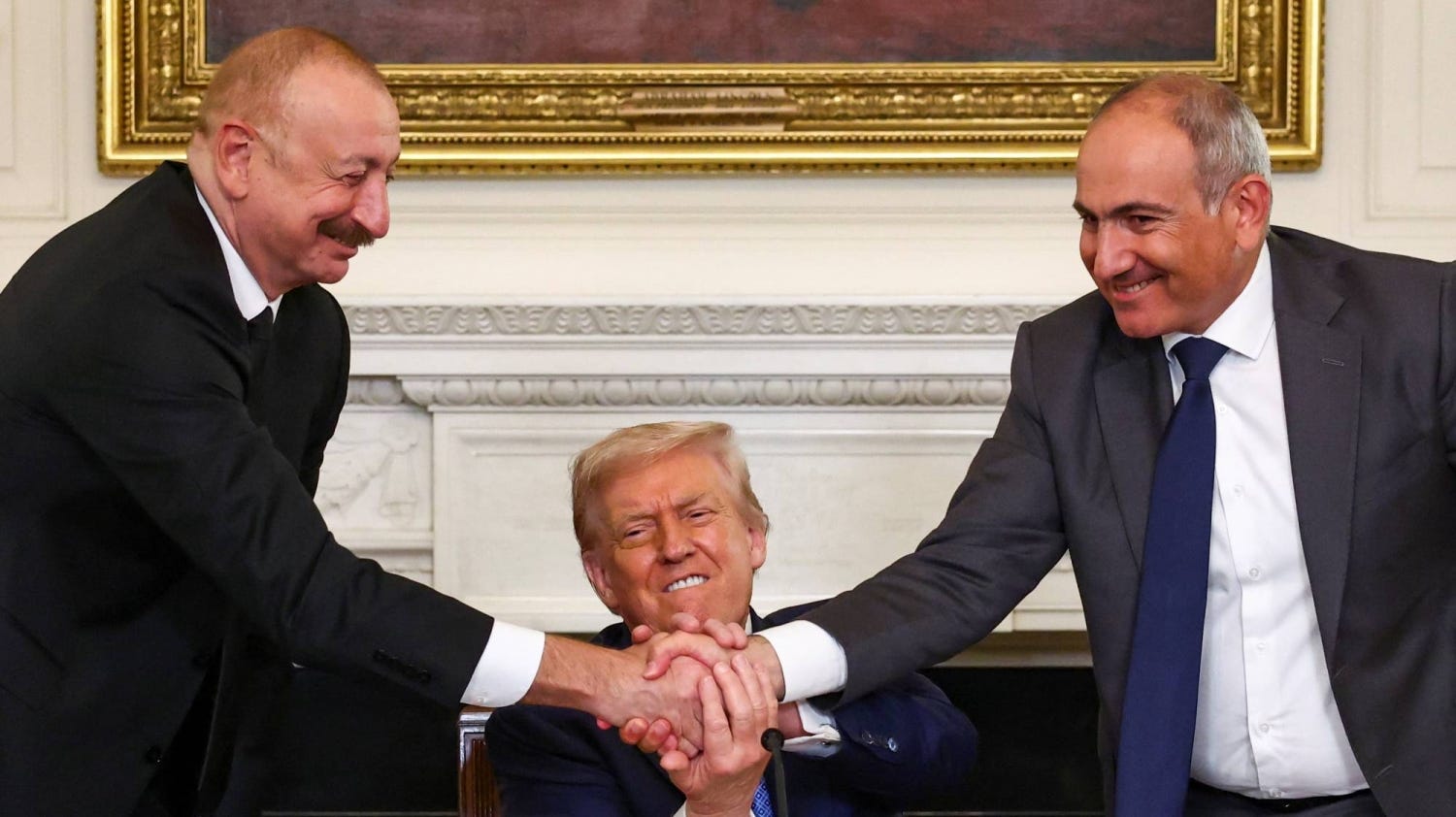
Both countries’ leaders say the Washington meeting restored peace in the region and have praised Trump’s intervention as a game changer. Trump claimed that Putin called him afterward to say, “I can’t believe you got that one settled.” That an outcome long described as politically impossible could shift without reconciling historical grievances or redrawing borders in a way that satisfies everyone is remarkable. Increasingly, decisive negotiations take place less over principles and more over corridors.
Securing those corridors is a vital interest for the United States. The White House’s latest National Security Strategy makes the priority explicit: “the United States must never be dependent on any outside power for core components—from raw materials to parts to finished products—necessary to the nation’s defense or economy.” Reaching that goal, however, takes time. Until then, control over secure routes is what determines leverage.
This is why the Armenia–Azerbaijan deal is not an isolated event. Few analysts are connecting these dots, but this is just one link in a larger chain that, if assembled successfully, will shape the post-war order emerging from the Ukraine conflict. How that chain comes together—or fails to—also serves as a bellwether for how a new U.S.–Russian relationship is taking form. Let’s see what pieces are still missing.

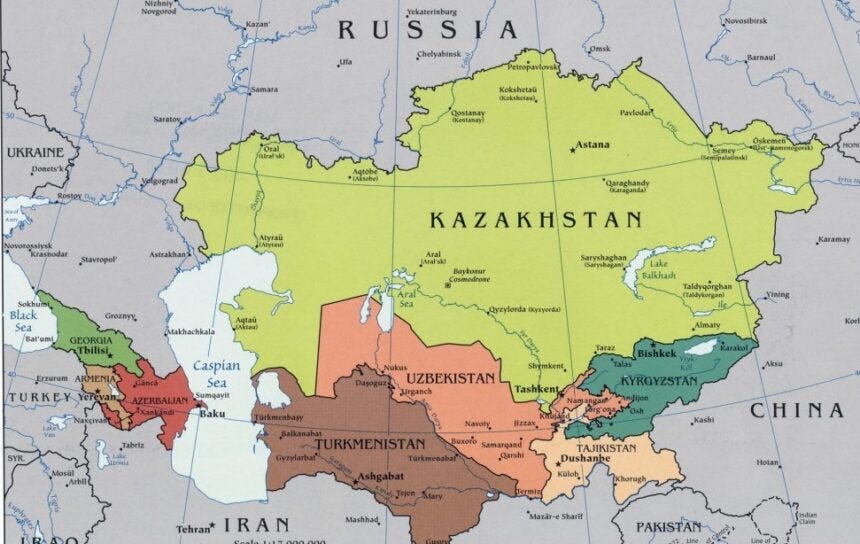
For the U.S., the new route is about gaining a foothold in Central Asia. In November, Trump hosted the leaders of five Central Asian nations—Kazakhstan, Kyrgyzstan, Tajikistan, Turkmenistan, and Uzbekistan—at the White House. The meeting signaled Washington’s intent to muscle into a resource-rich region long dominated by Russia and now increasingly courted by China. Reuters reported:
“One of the key items on our agenda is critical minerals,” Trump said. “In recent weeks, my administration has strengthened American economic security by forging agreements with allies and friends across the world to broaden our critical mineral supply chains.”
The talks took place amid intensifying competition for Central Asia’s vast mineral wealth -- which includes uranium, copper, gold and rare earths -- as Western nations move to diversify supply chains away from Moscow and Beijing.
The most direct path for moving minerals out of Central Asia while fully avoiding China runs through Turkey and then westward.
The Turkish government has already moved to capitalize on TRIPP. In August, Turkish officials held a groundbreaking ceremony for a new 224-kilometer (139-mile) rail line stretching from eastern Turkey to the frontier with Azerbaijan’s exclave. Ankara, however, approaches international cooperation in a highly transactional manner. It has repeatedly used access, approvals, and alignment as leverage to extract concessions elsewhere. TRIPP is no exception. Turkey is not content with merely providing rail infrastructure. It sees in the corridor a chance to lock in a long-standing ambition: positioning itself as Europe’s central energy hub.
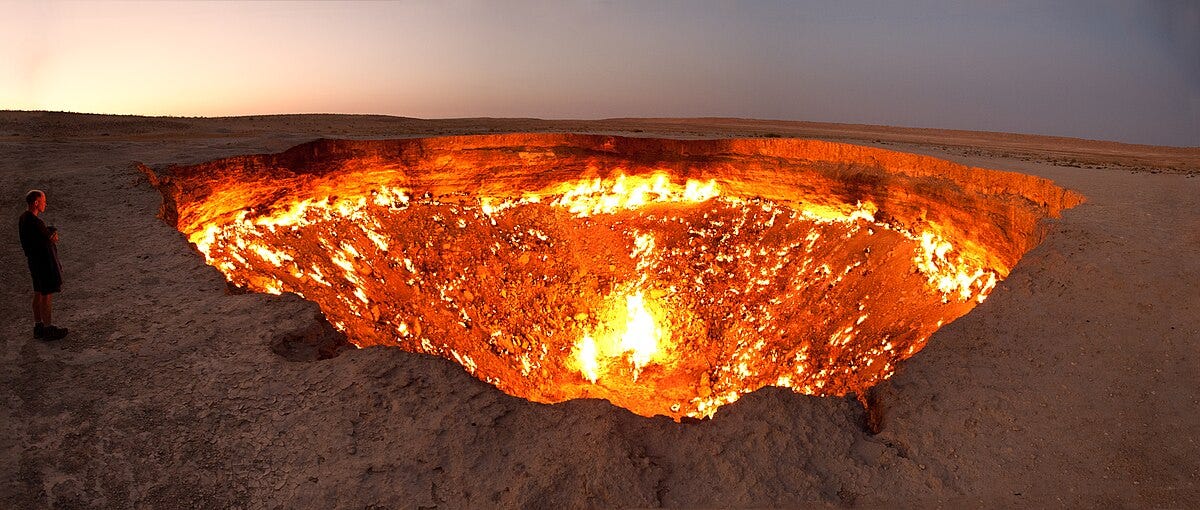
Turkmenistan sits at the heart of this ambition. The country holds the world’s fourth-largest proven natural gas reserves, and gas exports account for the vast majority of state revenue. The Darvaza gas crater—also known as the “Gate to Hell”—has burned continuously since 1971 after a Soviet drilling accident and serves as a material reminder of the scale of Turkmenistan’s reserves.
Those reserves are the only ones in Central Asia capable of supplying volumes large enough to matter for Europe. And for Ankara they are the difference between remaining a transit state and becoming a true energy hub. In effect, gas purchases routed through TRIPP could also be credited against Europe’s $750 billion energy commitment to the United States.
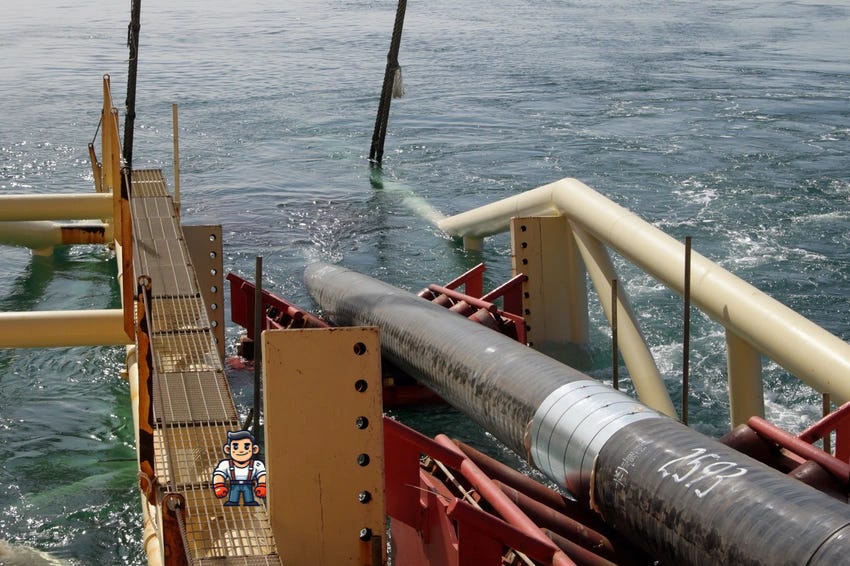
The only viable westward outlet for this gas runs across the Caspian Sea to Azerbaijan and from there into Turkey. But that link does not yet exist. Days ago, Turkey renewed its push for it:
Turkish Energy Minister Alparslan Bayraktar has said that Ankara is pressing for long-delayed plans to move Turkmenistan’s vast natural gas reserves across the Caspian Sea to Türkiye and Europe, calling the long-discussed Trans-Caspian pipeline “strategically essential” for the region’s energy security.
Speaking after hosting the 5th meeting of the Organization of Turkic States (OTS) Energy Ministers Council in Istanbul on Wednesday, Bayraktar said Türkiye formally proposed that the long-stalled project be “made concrete” and advanced in coordination with Azerbaijan, Turkmenistan and other regional partners.
“The ideal solution is for Turkmen gas to reach Türkiye — and from Türkiye, Europe — through a dedicated pipeline,” Bayraktar said, noting that Ankara currently imports Turkmen gas only through swaps. “This project has been on the agenda for nearly 30 years. It is time to operationalise it.”
This is where Russia comes in. As a Caspian Sea littoral, Moscow objects on environmental grounds, invoking seabed protections and review requirements under existing Caspian conventions. However, the true reason for its long-held opposition to a Trans-Caspian pipeline is that it would weaken its role in the region while expanding Turkey’s.
The relaxation of Russia’s veto therefore determines whether Turkey’s energy hub ambitions advance at all. And because Turkey’s long-term willingness to cooperate under Trump’s TRIPP plan ultimately depends on what it gets in return, the veto also functions as leverage against America’s plans in Central Asia.
In effect, it is a bargaining chip that can be relaxed at the right moment. In a negotiation environment shaped by sequencing and incentives, Russia’s position on the Caspian link becomes one of the clearest signals of whether a broader accommodation is taking shape. This is where the pipeline intersects with peace talks.
If negotiations between Washington and Moscow are serious—not just about Ukraine, but about post-war positioning—then Russia’s willingness to soften its Caspian stance becomes the litmus test. It’s the kind of concession that would only be made in exchange for durable gains such as credible security guarantees.
Crucially, the opposite is also true. If Russia maintains an absolute veto regardless of diplomatic progress elsewhere, it would indicate that trust remains too low for structural trade-offs and that any peace remains tactical rather than strategic. This is why the Trans-Caspian pipeline matters even if it is never built.
Two days ago, Putin met with the Turkish and Turkmen presidents at the International Forum of Peace and Trust in the Central Asian country’s capital, Ashgabat. Despite the lack of any corresponding press release, there can be little doubt that the Trans-Caspian pipeline was part of the talks.
From Moscow’s perspective, the greatest uncertainty is political. Any relaxation of the Caspian veto would be difficult to reverse, while the U.S. commitments attached to it could unravel if the midterms prove unfavorable for Trump. Therefore, if Russia moves on the pipeline, it shows confidence not just in a deal, but in its durability.
Amid mounting rhetoric—such as NATO Secretary General Rutte warning that Europe must prepare for the kind of war “our grandparents endured”—distinguishing signal from the noise of public conditioning is vital. Russia’s posture on this single corridor may end up saying more about the durability of any settlement than the language of any communiqué.
Share this with anyone trying to separate signal from noise!
🔈 I recently had the pleasure of being invited to The Money Levels Show. We had a wide-ranging conversation covering BRICS, EU fractures, and gold reserves. Listen here.
The Empire will pocket any Russian concessions, then renege on the agreement.
Great read. I searched for TRIPP for some more background and was rewarded with a meditation app, a clothing brand and a Canadian rock band. Thank God for Substack.