
Waiting for the Spark
New German employment data point to trouble for Europe
The term “elite overproduction” makes immediate intuitive sense. It lets you think of figures like Kaja Kallas, who holds the position of High Representative for Foreign Affairs—a role that should not exist in the first place. Foreign and security policy are core attributes of statehood. Representation and ultimate authority therefore rest with national governments.
But elite overproduction is more than a shorthand for polemical critique. It is one of the central concepts in an attempt to build a predictive science of history, developed by complexity scientist Peter Turchin, known as cliodynamics. This approach has nothing to do with grand theories such as Marxism or Social Darwinism—failed explanations that inflicted extraordinary suffering because their adherents believed history followed iron “laws” and felt entitled to coerce society in their name.

Cliodynamics is structural rather than deterministic. It does not claim to predict specific events, but to identify the conditions under which social pressures for instability build and eventually crest. As Turchin puts it:
Think of a forest in which deadwood has been accumulating for many years. We don’t know what will start the fire – it could be a lightning strike during a storm, or a careless match thrown away. But sooner or later such a precipitating spark will arrive, and there will be a massive conflagration.
Elite overproduction, according to this framework, describes a condition in which societies generate more claimants to authority, status, and influence than they can productively absorb. This creates a structural imbalance long before any overt crisis becomes visible. Elites in this sense aren’t the most intelligent, moral, or meritorious. They are simply a segment of society that concentrates social power in its hands.
As a result, elites claim a recurring share of an economy’s output. Because wealth is accumulated income, its growth depends on directing a portion of GDP toward those who control access to power and status—a dynamic that can push systems toward destabilizing tipping points, as Turchin documents across history.
This January, Germany’s Federal Statistical Office released data suggesting that the country may be moving uncomfortably close to such a threshold. To understand what this implies for Europe’s largest economy, it’s worth looking closely at the numbers.

Germany currently counts just under 46 million employed people. At first glance, that headline figure suggests stability. Yet it conceals a persistent reallocation beneath the surface.
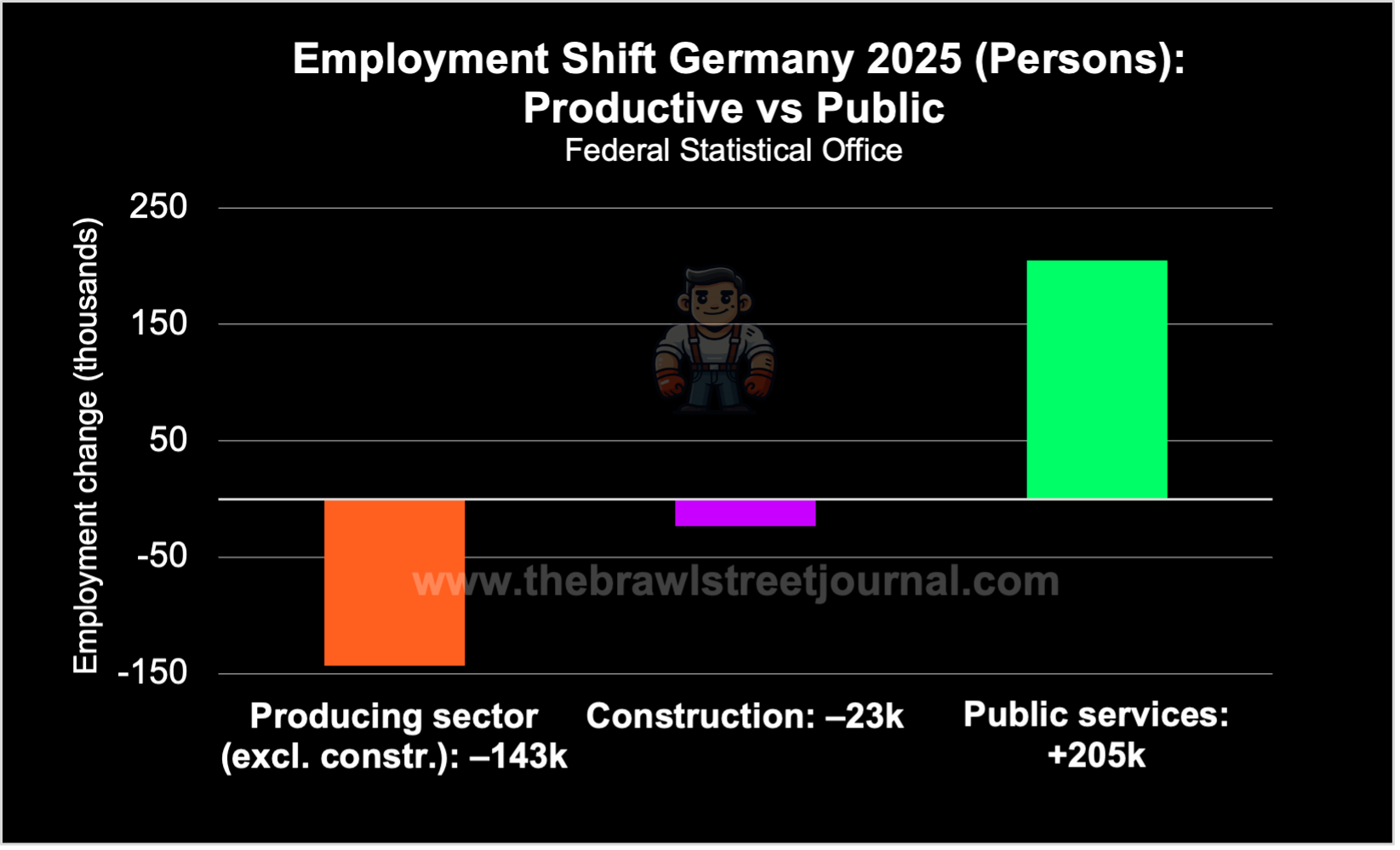
Employment has fallen where Germany’s productive core once lay. In the producing sector (excluding construction), the number of employed persons dropped sharply in 2025, falling by 143,000 (-1.8%) to 7.9 million. Construction followed the same trajectory. Employment in the sector declined by a further 23,000 workers (-0.9%), leaving 2.6 million employed in an industry that has long served as a bellwether for private investment and confidence.
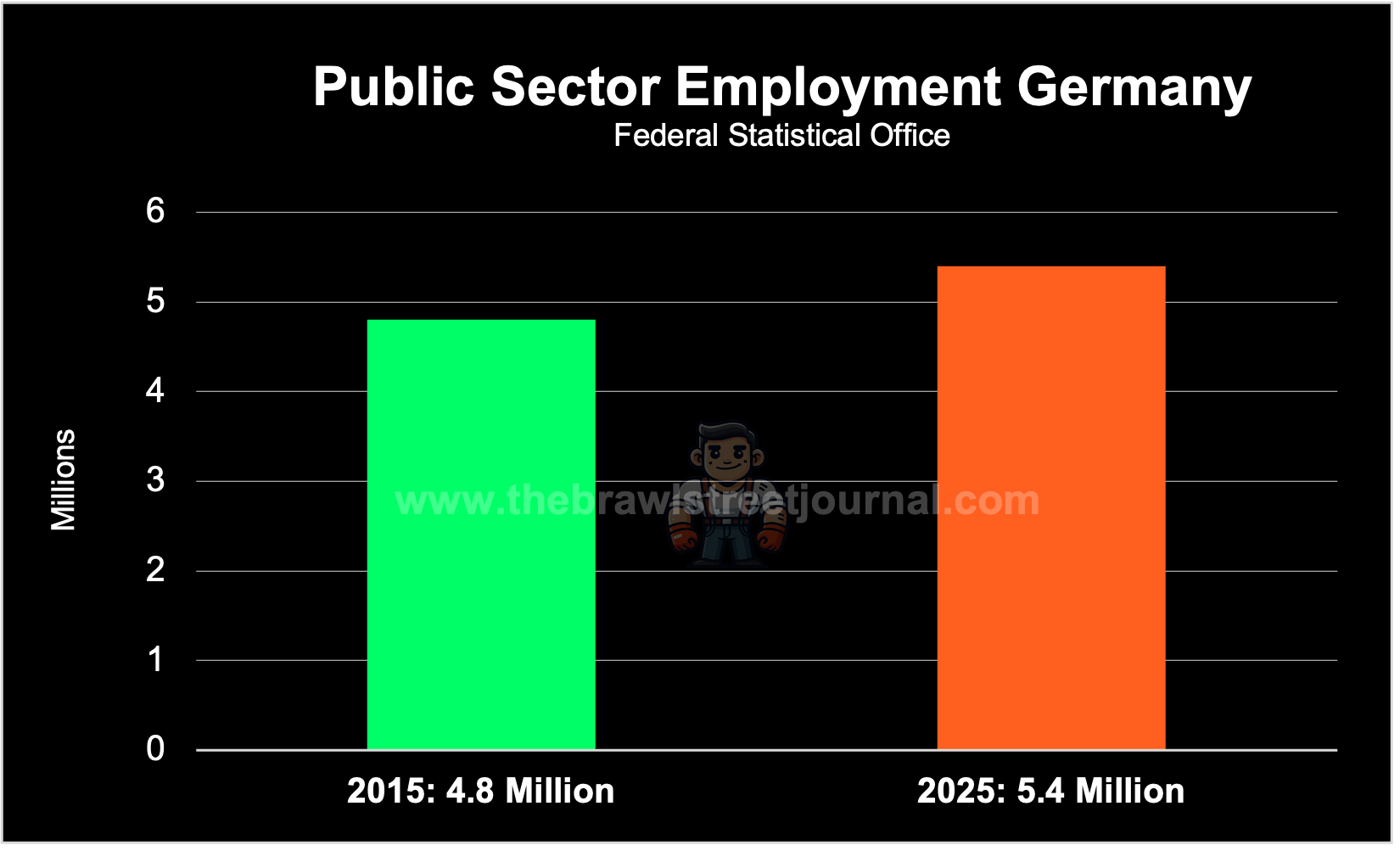
By contrast, the strongest employment gains once again occurred in the area of public services, including education and healthcare, which added 205,000 workers (+1.7%) in a single year. This is part of a longer-running pattern. Employment in the core public service has risen steadily from around 4.8 million in 2015 to roughly 5.4 million today.
Even these figures understate the scale of the shift because they capture only the core public sector. No reliable aggregate data exist for the expanding number of NGOs and formally private organizations that are wholly or partially financed by tax revenues. Nor is it easy to quantify the share of nominally private economic activity that depends heavily on politically determined subsidies. Entire segments of the green-technology sector, for example, would struggle to exist in their current form without sustained public support.
Taken together, the picture is not one of a shrinking workforce, but of a workforce being steadily reabsorbed into state-adjacent structures while employment declines in the sectors that generate tradable output and private investment.
The labor reallocation toward state-adjacent employment is mirrored at the macro level. In 2025, Germany’s government spending ratio—the share of total public expenditure relative to GDP—rose to 50.3%, crossing the 50% mark for the first time since Covid.
However, the state’s true footprint is likely larger still. Estimates put annual bureaucratic compliance costs at around €62 billion, covering the time and resources spent on tax filings, statistical reports, environmental rules, product safety requirements, sustainability and data protection reporting, among others. This amounts to an outsourcing of policy objectives that avoids appearing as public expenditure.
While not all of this spending benefits elites directly, it is nonetheless a function of elite expansion. As the number of claimants to influence and authority grows, administrative structures expand to absorb them. Rules proliferate and oversight deepens as positions require institutional justification. The result is rising public and state-adjacent employment—a transmission of elite pressure through bureaucracy, with the costs borne by the productive economy.
The hypothesis that elite overproduction may be approaching a “disintegrative” phase—as Turchin puts it—is reinforced by Germany’s growing dependence on transfers. Around 5.5 million people currently receive means-tested income support. When this figure is added to public-sector employment and state-adjacent, publicly financed activities, it exceeds the number of employees in Germany’s productive sectors. The accumulation of deadwood is becoming increasingly combustible.

Elite overproduction is not unique to Germany, of course. It also operates at the EU level, where administrative expansion has proceeded largely independently of economic cycles or political shocks. European Union institutions employed roughly 25,000 staff in 2000. By 2024, the figure had climbed further to more than 79,000. Prominent figures such as Kallas are merely the visible edge of this broader trend, with roles like the High Representative embodying the institutional solution to elite surplus.
Elite overproduction and expanding state control do not necessarily go hand in hand. The United States under Donald Trump suggests that a different path is possible. DOGE—whatever one thinks of its effectiveness—was presented as an effort to cut bureaucracy and internal roles rather than absorb competing claims through further expansion. At the same time, Trump has hardly been shy about exercising state power given his interventions: tariffs, export controls, pressure on the Federal Reserve.
Ultimately, the U.S. is betting that disruption can burn away accumulated deadwood, even at the cost of short-term instability.1 Europe has chosen to keep the forest orderly, dense, and governed, while allowing combustible material to accumulate beneath the canopy. Whatever the precise spark may be, the fuel is there.
Share this with anyone who thinks the forest is fine!

I’ve just started using X more actively. Following there is the simplest way to help BSJ grow and reach the right people: x.com/TheBrawlStreet
See you there!
Borrowing a metaphor introduced by Marvin Barth .
"In any bureaucratic organization, there will be two kinds of people: those who work to further the actual goals of the organization and those who work for the organization itself. The Iron Law states that the second group will always gain control, and will always write the rules under which the organization functions."
- Pournelle's Iron Law of Bureaucracy
It follows that the second group will seek to increase the size of the organization, inevitably at the expense of the organizational goals. This represents a reduction in efficiency - efficacy - at least equal to the rate of increase in staff, always accomplishing less with more.
there is a saying in the US, too many chiefs and not enough Indians, which describes this exact phenomenon succinctly. I am thankful that President Trump is seeking to reduce federal government employment aggressively, with the story the administration just altered the status of another 50K workers who can now be dismissed without union headaches. Senator Warren is up in arms because 50% of the Department of Education has been fired, whereas I would like to see the department removed completely.
to follow your metaphor, it appears that Trump is culling the deadwood and getting rid of it completely, reducing that longer term potential conflagration.